
Origins
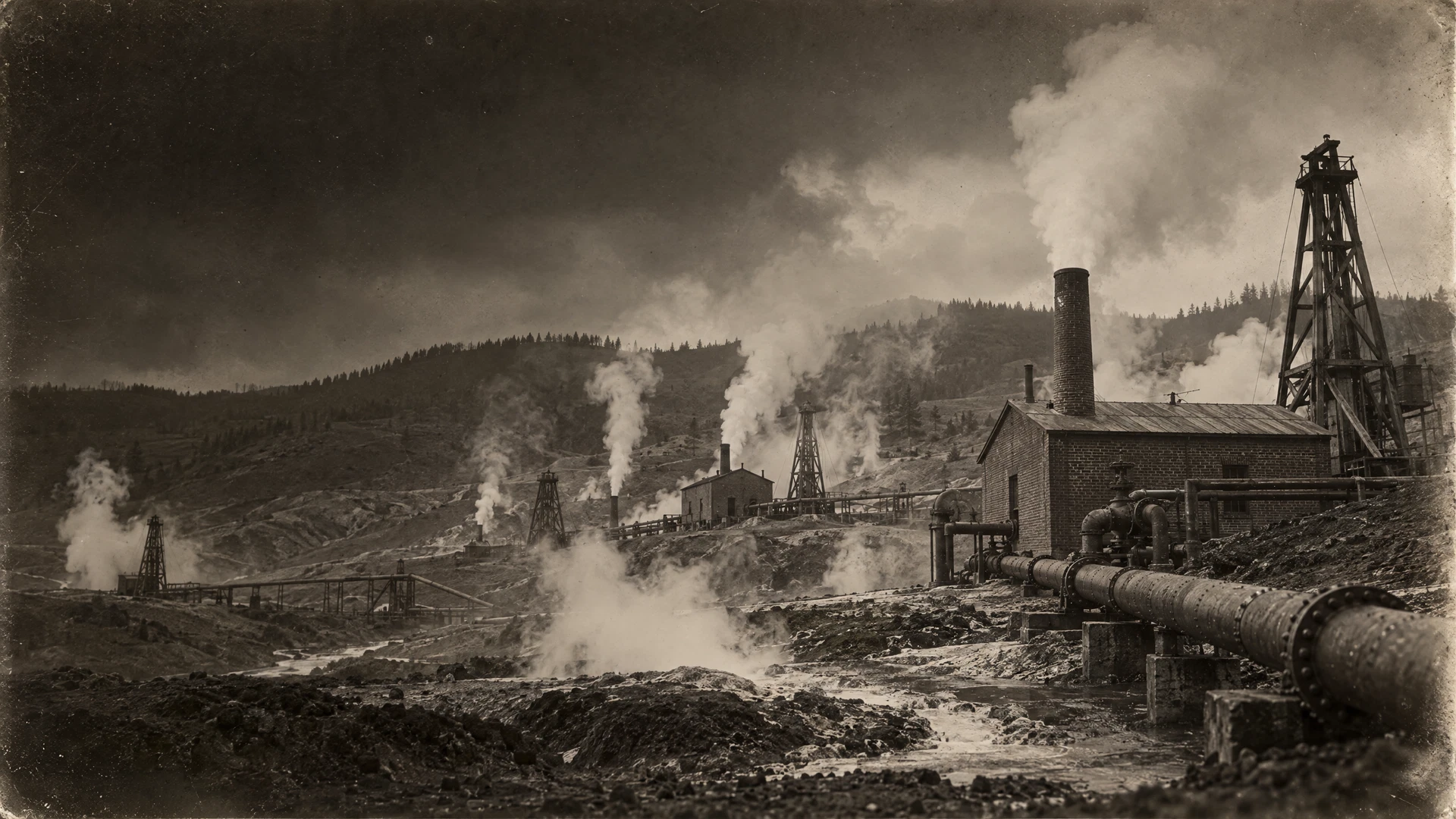
The 100-Year Pause
01 —The Lag
Why Geothermal Didn't Scale
But geothermal didn't scale—because the industry treated it like a drilling challenge instead of a materials + heat-transfer challenge.
Solar kept reinventing its core stack: silicon refinement, new device architectures, perovskite pathways, thin films—real step-changes in materials science. Geothermal didn't.
In many projects, we're still building around the same century-old backbone—steel, cement, conventional tubulars, conventional thermal interfaces—even though we know those components can behave like thermal resistors, bottling up conduction, limiting convection pathways, and forcing conservative operating envelopes.
02 —The GEIOS Approach
Moving to 3D
GEIOS moves to 3D. EQG is built on the premise that geothermal should be engineered as volumetric heat engagement—stimulate more rock volume, capture from more directions, control the system like infrastructure—not gamble on a thin slice of favorable conditions.
And it pushes the solution where geothermal has been weakest for 100 years: advanced materials + engineered interfaces + stimulation + AI-driven operations, down to the atomic and nano scales where heat routing and transfer can be meaningfully amplified.
Bottom line
Geothermal didn't lag because Earth ran out of heat. It lagged because the industry kept using yesterday's stack and yesterday's geometry. GEIOS is building the platform geothermal should have become decades ago.
3D · EQG
Volumetric heat engagement
- Stimulate more rock volume
- Capture from more directions
- Control the system like infrastructure
- Engineered interfaces at nano-scale
03 —Platform Shifts
A Short History of Platform Changes
4th Gen · GEIOS
2019
EQG
Engineer the interface.
Not just deeper wells—better physics: engineered heat-capture + operations designed for repeatability across broader geology.
Outcome
Geothermal moves from “site lottery” toward engineered infrastructure.
04 —Nanotechnology
The Missing Layer
For decades, the industry treated the working medium as a solved question: water, and later supercritical CO2, as carriers to move heat from rock to surface.
Those media work—but they're still "classic" fluids operating in a classic mindset: move energy through limited pathways, accept the thermal boundary layer, accept bottlenecks at the casing/interface, then compensate with bigger drilling or bigger surface hardware.
The next leap is to treat the medium like a designed material, not just a fluid.
- 01
Nanofluids
Engineered to behave like a continuation of the subsurface energy environment—coupling more effectively with kinetic energy, micro-vibrations, and thermal gradients in rock.
- 02
Colloidal Conductors
Trap and route heat more efficiently than bulk fluids—turning the casing and near-well environment into an active thermal interface rather than a passive barrier.
- 03
Continuous Chain
Instead of hard discontinuities (rock → steel/cement → fluid), the goal is a continuous heat-transfer chain where the interface is engineered, not tolerated.
- 04
SPARC-Aligned Corridors
Designed pathways that guide thermal transport intentionally, rather than relying on the "channel networks" and uneven flow paths that have challenged EGS. It's a shift from fracture networks you hope behave to heat corridors you design.
05 —The EQG Stack
Optimized for Repeatable Heat Engagement
GEIOS treats geothermal's ceiling as a systems ceiling. The old stack optimized for survivability and basic flow. EQG is positioned as a stack that optimizes for repeatable heat engagement.
- 01
3D Volumetric Engagement
Not 2D channel exchange
- 02
Engineered Interfaces
Not passive thermal resistance
- 03
Stimulation Control
Not a one-time gamble
- 04
AI-Driven Operations
Stable and predictable over time
- 05
Optional Value Stacking
Not locked into electricity only
In other words: the stack is designed so geothermal behaves like infrastructure you can deploy—again and again—rather than a one-off project you discover.
06 —The Value
The Firm-Power Gap
The world is running into a firm-power wall: electrification, industrial load, and AI/data infrastructure are accelerating demand, while intermittency pushes grids toward higher complexity and higher costs.
EQG targets the obvious gap: always-on energy that scales beyond rare hydrothermal hotspots—not by chasing depth alone, but by upgrading the physics and the platform.
Closing argument
Geothermal didn't fail because Earth ran out of heat. It stalled because the industry stayed in 2D, stayed in legacy materials, and called incremental drilling progress "innovation."
EQG is the bet that ends the 100-year pause—by turning geothermal into a designed, controllable, repeatable system.
Continue